
 Driven by curiosity. Driving change
Microscopy Development
Instrumentation
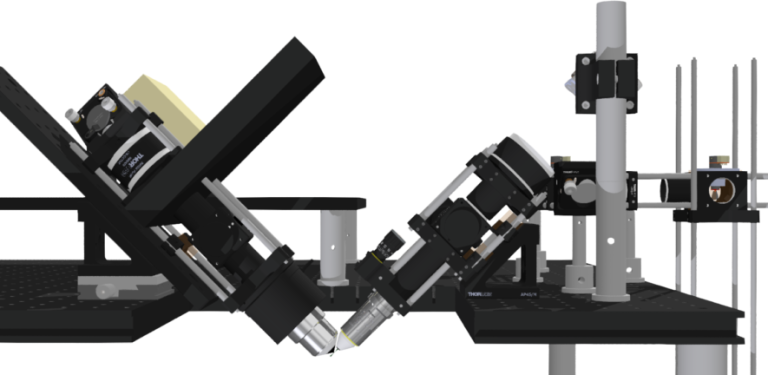
We have constructed instruments that permit imaging from the molecular scale (10 nm) to whole embryos spanning 100s of microns and containing 1000s of living cells.
Techniques we use include direct stochastic optical reconstruction microscopy (dSTORM), structured illumination microscopy (SIM), selective plane illumination microscopy (SPIM), fluorescence lifetime imaging (FLIM), fluorescence anisotropy imaging microscopy (FAIM), hyperspectral imaging, etc. You can find more details on these instruments in the equipment overview. The technology portfolio allows us to flexibly address a wide range of biological research questions.
Currently, we are developing variants of RESOLFT imaging with the group of Professor Stefan Hell in Göttingen, and SPIM with Dr Jan Felix Evers in Heidelberg, and SIM with Dr Kevin O’Holleran at the Cambridge Advanced Imaging Centre.
Theoretical research
Our experimental research is strongly backed up by theoretical work and activities in image processing. We have made contributions to the advancement of quantitative imaging in several fields, including global analyses of FLIM data and spectral unmixing, quantitative FRET assays that recover both FRET strength and stoichiometry of interactions, anisotropy imaging to measure rotational diffusion constants and homoFRET, point spread function fitting for superresolution imaging, and single-molecule diffusion trajectory imaging at superresolution. We have also performed theoretical research on frequency-domain FLIM, which has led to the discovery of two new experimental methods for conducting FLIM, one operating at higher speed and the other at better accuracy than alternative FD-FLIM techniques.