
 Driven by curiosity. Driving change
Research
The central theme of our work is the development and application of modern laser spectroscopy and imaging methods to elucidate details and dynamics of chemical processes.
Below you find summaries of, and links to, key research projects currently going on in the group.
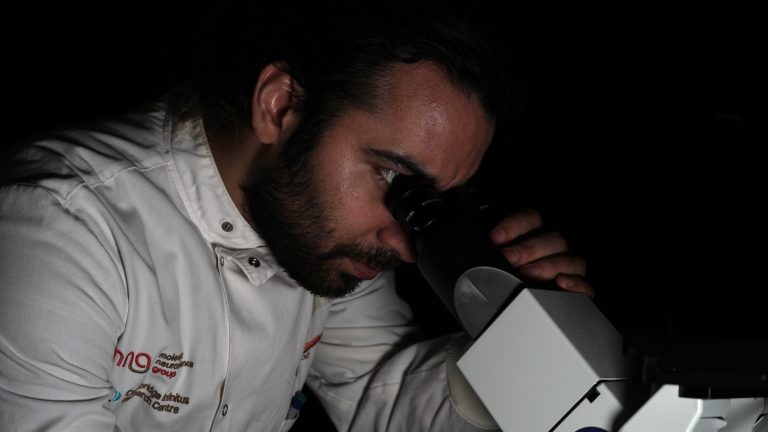
Dynamic live cell imaging at sub-zero temperatures
In a groundbreaking collaboration between the Department of Chemical Engineering and Biotechnology (CEB) and the British Antarctic Survey (BAS), we are pioneering dynamic live cell imaging at sub-zero temperatures.
One of just 36 projects funded by the UKRI cross research council pilot scheme, this initiative aims to develop advanced microscopy capable of observing living cells at cold.
By bridging biology, physics, engineering, and chemistry, the project promises transformative insights into how life adapts in extreme environments.
→ Read more
Molecular mechanisms of disease
We use a range of advanced biological and biophysical methods to probe the molecular chemistry of disease in live cells and in animal models. Currently a major focus is on the study of protein misfolding and aggregation in neurodegeneration.
→ Read more
Microscopy development
We perform both experimental and theoretical work to optimize speed, resolution, and sensitivity for applications ranging from single molecule biophysics to whole organism imaging.
→ Read more
Molecular sensing
The generation of broad bandwidth supercontinuum generation is central to much of our research in molecular spectroscopy and imaging. For an overview of methods we use see. Previously we performed a lot of molecular imaging in reactive gas flows, an area we are less involved in now.
→ Read more
Free resources
We have made a number of resources freely available. From methods to MATLAB code to our flat flame calibration burner.
→ Read more
Equipment
Browse a list of our key equipment by clicking below.
→ Read more
Sponsors
Our work is generously sponsored by grants from a variety of agencies and institutions from around the world.